Government backs KNUST innovation drive with agricultural machinery, traffic-light projects
The Kwame Nkrumah University of Science and Technology (KNUST) is to partner with the Ministry of Food and Agriculture to develop locally manufactured agricultural machinery and other technologies, officials said Friday. The initiative is aimed at reducing the country’s reliance on imported equipment and increasing the...
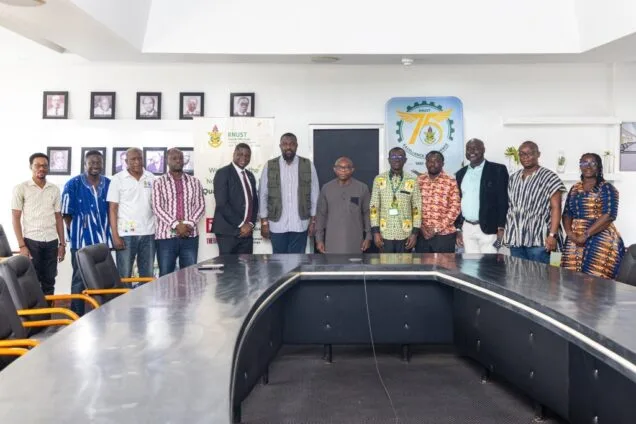
The Kwame Nkrumah University of Science and Technology (KNUST) is to partner with the Ministry of Food and Agriculture to develop locally manufactured agricultural machinery and other technologies, officials said Friday.
The initiative is aimed at reducing the country’s reliance on imported equipment and increasing the use of locally developed technologies in government projects.
Deputy Minister for Food and Agriculture John Dumelo said the government should increasingly award contracts to Ghanaian universities to develop and manufacture solutions to the country’s challenges.
“We should be able to change the norm to allow most of our university students to come up with designs that we can expand on to reduce importation,” Dumelo said during a meeting with KNUST Vice-Chancellor Professor Christian Agyare.
He proposed that KNUST’s engineering departments lead the design and production of agricultural machines and tools that could be deployed to farmers across the country.
Agyare described the proposal as a “laudable initiative”, saying it was consistent with the university’s strategy of translating research and expertise into practical solutions.
The two sides also discussed plans to develop locally manufactured smart traffic lights for Dumelo’s Ayawaso West Wuogon constituency in Accra.
Professor Eric Tutu Tchao, Scientific Director of KNUST’s DIPPER Lab, said the proposed traffic-light project would involve collaboration between the university’s College of Engineering and College of Science.
Dumelo, a former KNUST student, said traffic lights had previously been developed by students at the university and expressed interest in reviving the initiative.
“We would like to explore the possibility of engaging KNUST students and faculty to design and manufacture systems that could be deployed within the constituency,” he said.
He said the project could eventually serve as a model for similar locally developed traffic systems across Ghana.
KNUST said its DIPPER Lab would lead the technical implementation of the traffic-light project, working with experts from the two colleges.
The university’s vice-chancellor assured the ministry of KNUST’s technical support for both initiatives.