Chief Justice Baffoe-Bonnie: Access to legal education must not come at the expense of quality
The Chief Justice, Paul Baffoe-Bonnie has called for the careful implementation of Ghana’s new legal education reforms, stressing that expanding access to professional legal training must not result in a decline in standards. Delivering the keynote address at a colloquium organised by the Central Law School of Central...
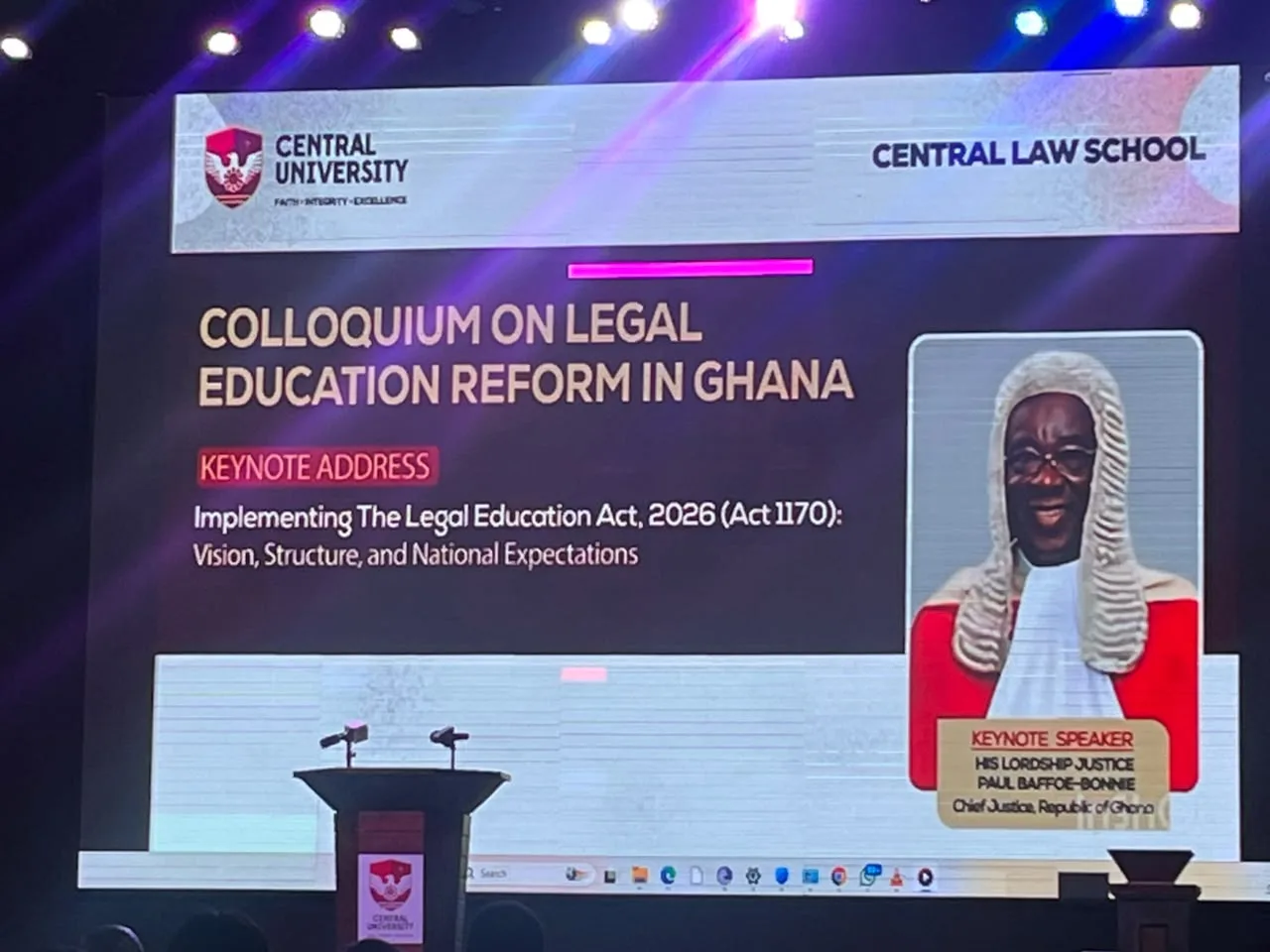
The Chief Justice, Paul Baffoe-Bonnie has called for the careful implementation of Ghana’s new legal education reforms, stressing that expanding access to professional legal training must not result in a decline in standards.
Delivering the keynote address at a colloquium organised by the Central Law School of Central University here in the capital on Thursday (11 June, 2026), the Chief Justice described the Legal Education Act, 2026 (Act 1170), as a landmark reform aimed at addressing longstanding challenges in Ghana’s legal education system.
“There was a constitutional call for greater fairness, accountability and equal opportunity,” Justice Baffoe-Bonnie said.
He noted that many qualified law graduates had for years struggled to gain admission into professional legal training due to institutional constraints.
“For far too long, institutional limitations have frustrated thousands of qualified lawyers. This act democratises opportunity,” he stated.
The Chief Justice said the new legal framework seeks to expand access while preserving professional standards.
“Access must never mean lowered standards,” he stressed.
“Lawyers are officers of the courts, guardians of constitutionalism, protectors of rights and custodians of the rule of law.”
According to him, the success of the reforms will depend not only on legislation but also on the readiness of institutions responsible for implementing them.
“Laws do not implement themselves. Institutions do,” he said.
Collaboration, not competition.
Justice Baffoe-Bonnie also urged law schools across the country to embrace cooperation rather than unhealthy competition.
“The future of legal education in Ghana must be characterised not merely by institutional excellence but by institutional cooperation,” he said.
He called for joint research projects, faculty exchanges, collaborative publications, and inter-university moot court competitions to strengthen legal education nationwide.
“No law school, however distinguished, possesses a monopoly of wisdom, expertise or innovation,” he added.
The Chief Justice further emphasised the need to modernise legal education to reflect emerging global realities, including artificial intelligence, cyber security, data protection and digital commerce.
“The lawyer of tomorrow must be technologically literate, commercially aware, clinically skilled and globally competitive,” he noted.
Most significant reform in legal education
Dean of the Central Law School, Professor Kenneth Agyemang Attafuah, described Act 1170 as a watershed moment in the country’s legal education landscape.
“It represents easily the most significant and audacious reform of our legal education system in our history,” he said.
Professor Attafuah explained that the act provides an opportunity to expand legal training, improve quality assurance, and align legal education with the needs of a rapidly changing society.
He said the colloquium was intended to help stakeholders understand the implementation requirements of the new law and assess institutional readiness for accreditation.
“Our objective is not simply to discuss a new statute. Rather, we seek to create a national platform for informed dialogue, collaborative problem-solving and strategic planning concerning the implementation of Act 1170,” he stated.
The objective is to produce better lawyers.
Vice-Chancellor of Central University, Professor Kwasi Dartey-Baah, said the success of the reforms should be measured by the quality of lawyers produced rather than the number trained.
“The objective of the act cannot simply be to produce more lawyers. The objective must be to produce better lawyers,” he said.
He stressed the importance of producing lawyers who are ethically grounded and responsive to societal needs.
“Lawyers who see the law not merely as a profession, but as a public trust,” he added.
Professor Dartey-Baah also warned against sacrificing quality in the pursuit of expanded access.
“Access without quality is dangerous. Quality without access is exclusion. The future demands both,” he said.
The colloquium was held under the theme: “Implementing the Legal Education Act, 2026 (Act 1170): Institutional Readiness, Accreditation and the Future of Legal Training”.
The event brought together judges, legal practitioners, academics, regulators and students to discuss the implementation of Ghana’s legal education reforms following the passage of Act 1170.
The legislation, signed into law by President Mahama on 11 May 2026, ended the Ghana School of Law’s 66-year monopoly on professional legal training and opened the door for accredited institutions to offer legal practice education.
Report by Clankson Acheampong for Asaase News in Accra.