Democracy now fought online as AI fuels misinformation, CJID summit hears
Journalists, policymakers, media regulators and democracy advocates have called for stronger regional cooperation to combat disinformation, regulate digital platforms and strengthen independent journalism, warning that artificial intelligence and social media are rapidly reshaping the threats facing democracy across We...
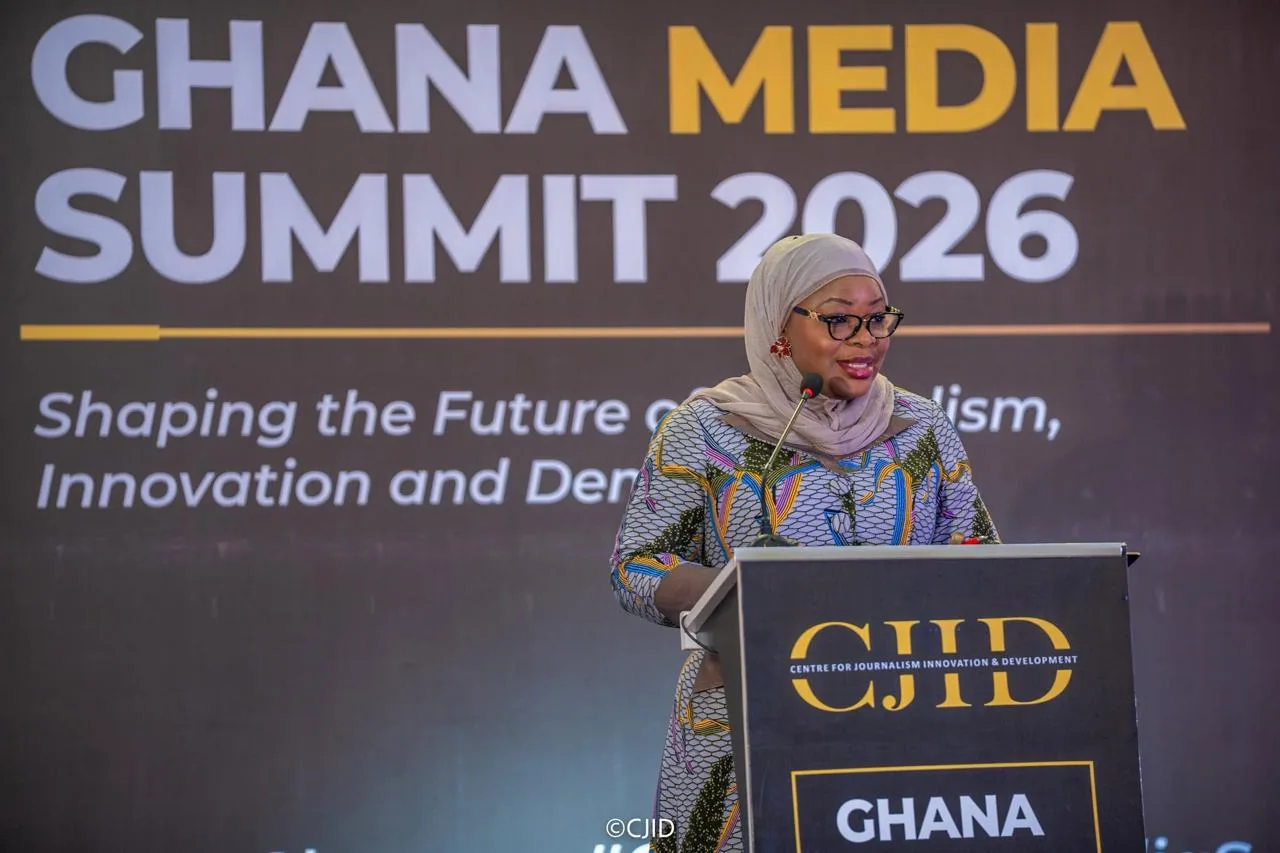
Journalists, policymakers, media regulators and democracy advocates have called for stronger regional cooperation to combat disinformation, regulate digital platforms and strengthen independent journalism, warning that artificial intelligence and social media are rapidly reshaping the threats facing democracy across West Africa.
The calls were made on Thursday (9 July)at the inaugural Centre for Journalism Innovation and Development (CJID) Ghana Media Summit, organised by the Centre for Journalism Innovation and Development (CJID) to commemorate seven years of DUBAWA Ghana.
The summit, held under the theme “Defending Democracy in West Africa: The Role of the Media,” brought together media practitioners, government officials, academics and civil society leaders to examine the future of journalism in an increasingly digital information ecosystem.
Delivering the keynote address on behalf of President John Mahama, government spokesperson Shamima Muslimsaid the greatest threat confronting modern democracies was no longer censorship or authoritarian rule alone, but the “weaponisation of information” through artificial intelligence, synthetic media and coordinated disinformation campaigns.
“Today democracy is contested not only in parliaments, courtrooms or at the ballot box, but across digital platforms, artificial intelligence systems and social media networks where information travels faster than verification,” she said.
Citing the World Economic Forum’s Global Risks Report 2025, Muslim noted that misinformation and disinformation had been identified as the world’s most severe short-term risk for the second consecutive year. She also referenced the Reuters Institute Digital News Report 2025, which found that 73 percent of Africans were concerned about distinguishing truth from falsehood online—the highest level recorded globally.
“The battlefield has changed. The weapons have changed. The speed has changed. But our mission remains the same—to defend truth, protect public trust and ensure facts, not falsehoods, shape our democracies,” she said.
She described journalism as “democratic infrastructure,” arguing that its importance now extends beyond the traditional notion of the media as the “fourth estate.”
“Just as roads connect cities and hospitals preserve life, the media sustains democracy itself,” she said, urging journalists to embrace skills such as digital verification, open-source intelligence, cybersecurity and data journalism to respond to emerging threats.
Muslim also said media literacy should now be regarded as both “a democratic imperative and a national security priority,” arguing that every smartphone user had become both a consumer and publisher of information.
She cited Ghana’s improved ranking in the 2026 World Press Freedom Index, where the country climbed from 52nd to 39th position, and pointed to ongoing consultations on the proposed Misinformation, Disinformation, Hate Speech and Publication of Other Information Bill as evidence of government’s efforts to balance freedom of expression with public safety.
Executive Secretary of the National Media Commission,George Sarpong, said West Africa’s democratic difficulties were being compounded by political polarisation, economic hardship, insecurity and the rapid spread of false information through digital platforms.
He argued that the region had entered what he described as the “Age of Disinformation”—an era defined not by technological progress but by a crisis of truth and public trust.
“Our challenge is no longer the scarcity of information but the collapse of confidence in what is true,” Sarpong said.
He warned that social media algorithms increasingly rewarded emotional and sensational content over credible reporting, while advances in artificial intelligence had made misinformation cheaper to produce and more difficult to detect.
He called for transparent, multi-stakeholder regulation of digital platforms involving governments, technology companies, regulators, academia, civil society and the media, cautioning that governments should not become “the arbiters of truth.”
“The first casualty of disinformation is truth. The second is trust. The third is democracy itself,” he said.
CJID Executive Director Akintunde Babatunde said the organisation was expanding its work beyond fact-checking to help media organisations survive shrinking funding and confront emerging digital threats across West Africa.
He said CJID was supporting investigative journalism, environmental reporting, artificial intelligence research and digital verification training across multiple countries in the region.
“We cannot talk about the information ecosystem today without talking about generative AI tools like ChatGPT and Gemini that can be used to scale disinformation, especially during elections,” Babatunde said.
He said journalists attending CJID’s regional open-source intelligence workshop had received training in advanced investigative tools to help identify AI-generated content, track coordinated influence operations and improve cross-border investigations.
Director for Policy Engagement and Partnerships at the Centre for Democratic Development (CDD-Ghana), Kojo Asante, argued that democracy itself was not failing, but rather the way governance systems had delivered development and public services.
“When people compare democracy with other political systems, what they are often reacting to is poor governance, not democracy as a principle,” he said.
Executive Director of the Media Foundation for West Africa, Sulemana Braimah, said discussions on media freedom should distinguish journalism from the broader digital content economy now dominated by social media platforms.
He argued that many content creators were driven primarily by economic survival rather than public interest journalism, while professional newsrooms continued to struggle against platform algorithms that prioritised engagement over accuracy.
“The crisis is really a crisis of journalism,” Braimah said. “We must find ways to rebuild trust in journalistic media while recognising that the digital information ecosystem now operates under completely different incentives.”
Investigative journalist Manasseh Azure Awuni said the speed of digital publishing had fundamentally changed journalism, forcing reporters to compete not only with one another but with millions of social media users publishing unverified content.
“The biggest weapon we have is credibility,” he said. “And credibility itself is under attack.”
Azure said journalists increasingly had to spend time disproving false claims circulating online rather than focusing solely on original reporting.
CJID Chief Executive Officer Dapo Olorunyomi argued that journalism and democracy could no longer be treated as separate disciplines.
He said media development efforts in Africa had traditionally focused on strengthening individual news organisations but should now prioritise building resilient democratic information ecosystems capable of responding to artificial intelligence, platform dominance and cross-border disinformation.
“The central purpose of journalism is to make democracy functional,” Olorunyomi said.
He urged journalism schools across West Africa to redesign their curricula to reflect the realities of the digital age by integrating computational journalism, artificial intelligence, data analysis and open-source intelligence into newsroom training.
He also called for greater regional cooperation on digital platform regulation, saying no single African country could effectively negotiate with global technology companies alone.
The summit concluded with renewed calls for stronger investment in fact-checking, media literacy, newsroom innovation and regional collaboration as West African countries prepare for future elections in an increasingly complex digital information environment.