Opinion: Mahama’s national security experiment: When the president finally stops playing with fire
There are certain institutions with which a serious President may experiment. He may rearrange the furniture at the Ministry of Tourism, change the colour of government letterheads or appoint a committee to investigate why another committee has not submitted its report. But national security is not one of them. Preside...
There are certain institutions with which a serious President may experiment. He may rearrange the furniture at the Ministry of Tourism, change the colour of government letterheads or appoint a committee to investigate why another committee has not submitted its report. But national security is not one of them.
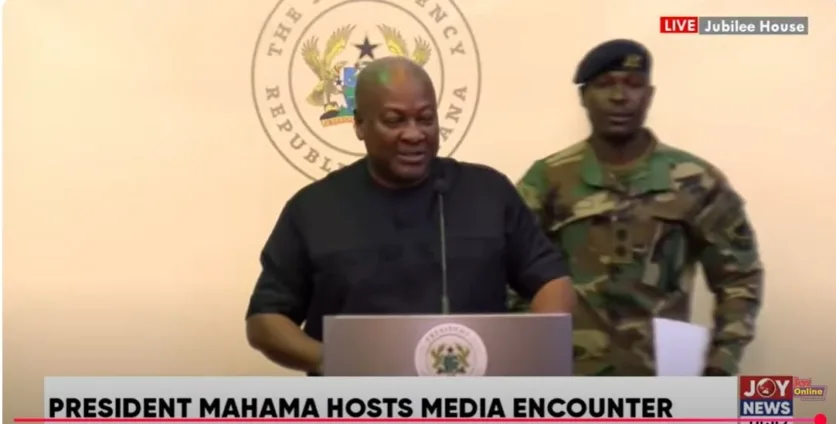
President John Dramani Mahama’s decision to reorganise the National Security Council Secretariat after one year of a state of disoriented inertia and maladroit listlessness, is therefore welcome. Indeed, it is refreshing.
It suggests that the President has finally recognised that the security of Ghana cannot be entrusted to political adventurers and desperate job-seeking loyalists merely because they shouted the loudest when the party was in opposition.
Better late than never. But when armed extremist groups are drifting southwards from the Sahel, “late” can be a dangerously expensive word. But, let us not be surprised by John Mahama. In him we have a leader who decided to leave the key office of substantive Minister of Defence vacant for an entire year to honour the Minister who died in a helicopter crash with five others. Nice gesture, but…
The Dangerous Politics of Rewarding Party Loyalty
When President Mahama returned to office in January 2025, his government appeared determined to treat the National Security Secretariat as an employment agency for political loyalists. Characters whose principal qualification seemed to be their political usefulness were brought into a highly specialised institution that demands discipline, discretion, training and years of professional experience.
At the same time, some capable officers who had served the previous government diligently were sidelined, rendered redundant, sent to ‘Siberia’ or treated as politically contaminated.
Their offence was not that they had betrayed Ghana. Their offence was apparently that they had professionally served the government Ghanaian voters had elected before January 2025.
What precisely were they expected to do before 2025? Refuse to work because the NPP was in power? Sabotage the state in anticipation of an NDC victory? Intelligence officers serve the Republic, not the party in government. The moment we begin to punish them for serving one administration faithfully, we teach their successors that political allegiance is more important than professional duty. That is how institutions are destroyed.
A competent intelligence officer does not suddenly become incompetent because a new President has taken the oath of office. Experience acquired over decades does not expire at midnight on 7 January.
Terrorists do not ask whether the officer monitoring them is NPP or NDC. A porous border does not become secure because the new man in charge owns the correct party card. Yet Ghana continues to behave as though every change of government must be followed by the ritual slaughter of institutional memory.
A One-Man Show at the Apex
The result was predictable. For 18 months, the National Security Council Secretariat drifted towards, what insiders described as a disorganised and dangerously centralised one-man show. Established hierarchies became blurred, specialist functions were weakened, professional morale suffered and coordination deteriorated.
National security is not a roadside drinking spot where one gentleman holds the key, pours the drinks, collects the money, settles disputes and decides who may sit on which chair. It is also not a cashier department where leaders demand GHS150 million from or for which fund, we may never know.
It is a complex architecture of intelligence gathering, analysis, operations, logistics, human security, counterintelligence and inter-agency coordination. No single individual, however politically favoured, can competently perform all these functions from one desk.
When authority is excessively centralised, intelligence becomes hostage to one person’s judgment. Information is delayed, inconvenient assessments are suppressed, professionals become reluctant to speak and warning signals disappear into administrative confusion.
That would be reckless even in peaceful times. It is close to madness when extremist organisations operating across the Sahel are searching for weaknesses along the northern borders of coastal West Africa.
Take the Accra Initiative, for instance, a Ghana-led initiative that has since lost being a project those in charge now appear to have lost the initiative for. Quite worryingly for some observers, President Mahama was, quite frankly, joking with Ghana’s security.
The Professionals Return
That is why the reorganisation announced on 11 August 2026 deserves support. The appointment of Major General (Rtd.) William Ayamdo as Deputy National Security Coordinator responsible for Operations introduces military command experience and operational discipline at a time when Ghana desperately needs both.
The return of Mr Yaw Donkor, a former National Security Coordinator, as Director of Intelligence and Research also restores institutional memory and analytical depth to the system. The changes affecting logistics, human security and special investigations suggest that the President has finally accepted that national security cannot be run as one large, confused political errand.
These appointments are not merely changes of personnel. They are an admission, whether the government says so or not, that the original arrangement was not working and putting all of us in harm’s way.
So, we should welcome that admission, however, tacit. A President who corrects his mistake is preferable to one who stubbornly protects it while the country pays the price.
But Ghanaians must also ask why the mistake was made in the first place. Why were experienced professionals pushed aside? Why was such a critical institution allowed to descend into confusion?
Why must a new government first dismantle a functioning structure before discovering, several months later, that experience and competence are useful after all?
Must Ghana always burn down the kitchen before remembering that the discarded cook knew the recipe?
Security Officers Serve Ghana, Not Governments
The deeper problem extends beyond President Mahama and the NDC. Successive governments have, at various degrees, treated the security services as partisan inheritance. Every administration arrives with its own favourites, suspects the professionals it inherited and attempts to construct a parallel security arrangement loyal to the governing party. This practice is dangerous, wasteful and profoundly unintelligent.
Ghana will not go far if every change of government means purging experienced officers, discarding institutional memory and recruiting replacements on the strength of party loyalty. National security cannot be rebuilt every four or eight years like a campaign office.
The police officer who arrests an armed robber under an NPP government must remain capable of arresting one under the NDC. The intelligence analyst who monitors an extremist network under President Akufo-Addo does not lose that expertise merely because President Mahama has taken office. The soldier guarding Ghana’s frontier is defending a republic, not a party headquarters in Adabraka or Asylum Down.
If professionals believe that serving one government diligently will cost them their careers under the next, they will begin serving politicians instead of serving Ghana. That would be the ultimate corruption of the security state.
President Mahama’s reorganisation is therefore both good news and a cautionary tale. It is good news because professional competence and institutional order appear to be returning to the apex of our security architecture. It is a cautionary tale because Ghana should never have been exposed to this unnecessary experiment in the first place.
Our peace was not created by accident. It was built through sacrifice, professionalism, institutional continuity and the quiet work of men and women whose names will never appear on political billboards.
The President has now seen the error of his ways and begun correcting it. For that, he deserves measured commendation. But next time, Mr President, please remember: national security is not where a government goes to reward the boys. The enemies of Ghana will not wait patiently while the boys learn on the job.
By Dr Kofi Omintimminim Apesemaka