African AI must move from vision to execution — AlphaVecta CEO
Africa must stop relying primarily on imported artificial intelligence (AI) systems and begin building technologies tailored to the continent’s own problems, Carlos Amoako, founder and CEO of AlphaVecta Technologies, has said. Amoako said Africa had the talent and a young, ambitious population capable of competing glob...
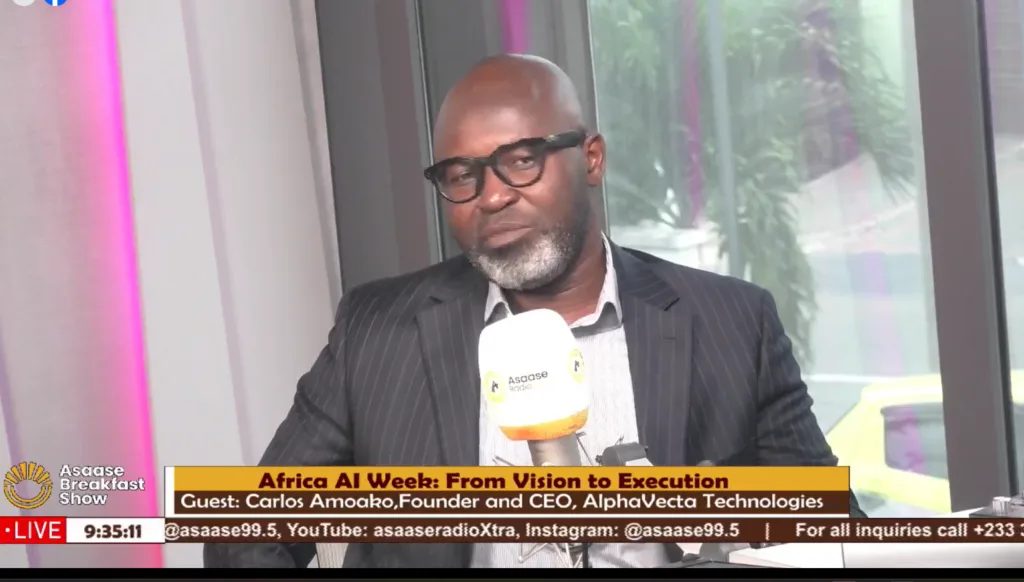
Africa must stop relying primarily on imported artificial intelligence (AI) systems and begin building technologies tailored to the continent’s own problems, Carlos Amoako, founder and CEO of AlphaVecta Technologies, has said.
Amoako said Africa had the talent and a young, ambitious population capable of competing globally in AI, but weak systems, limited resources and a tendency to allow decisions to be made from outside the continent had slowed its progress.
“For too long, we cannot keep being driven forever. We have to start building,” Amoako said in an interview on the Asaase Breakfast Show on Monday (17 August).
He said African countries had often been “last to the table”, with important decisions about technology made by actors outside the continent.
“We have the talent. There’s a lot of talent in Africa. Probably the systems are not that strong,” he said.
Amoako said the continent should shift its mindset from asking where it could buy technology to asking how it could build solutions to its own problems.
He identified financial inclusion, healthcare and agriculture as three areas where AI could have an immediate impact in Ghana.
Financial inclusion, he said, was important because of the continent’s rapidly expanding fintech sector and the dependence of households and businesses on financial services.
AI could also help expand access to primary healthcare, particularly for people in underserved communities, while agricultural applications could help farmers determine when to plant, harvest and apply fertiliser.
“We depend on the land. At the end of the day, it’s what sustains us,” Amoako said.
He said such technologies did not necessarily need to be sophisticated applications requiring smartphones, suggesting that information could be delivered through SMS and other accessible channels.
Amoako also called for greater investment in African datasets and languages, saying AI systems would struggle to serve the continent effectively if they were developed primarily around foreign languages and datasets.
He pointed to applications designed to deliver health information in local languages to people who may be unable to read English.
“We need more engineers to actually start continuing building these datasets and making it available,” he said, adding that datasets should be made as widely accessible as possible.
He said startups were already working to compile datasets in different African languages that developers could use to build locally relevant applications.
Amoako acknowledged that Africa still faced gaps in computing infrastructure, investment and datasets but argued that waiting for ideal conditions would delay progress further.
“We cannot wait. We need to start,” he said.
He cited Ghana, Morocco, Kenya, Egypt, South Africa and Nigeria as countries making progress in AI and said Ghanaian authorities were working to establish infrastructure that could support the country’s ambitions to become an AI hub.
However, he said governments needed to improve how resources were allocated and maintain continuity when administrations changed.
“Somebody may start something good and then the next government stops it,” he said.
Amoako said the continent also needed a change in mindset, particularly among institutions and decision-makers.
For Ghanaian businesses, Amoako said AI should no longer be viewed simply as a global technological trend but as a productivity and competitiveness tool.
He said companies could identify repetitive tasks that consume employees’ time and use AI to automate parts of those processes.
“If you’re spending five hours processing a certain workflow and now you’re spending half an hour, you can definitely measure” the return, he said.
The gains, he added, could allow employees to spend more time on higher-value tasks while improving productivity and work-life balance.
Amoako rejected the notion that Africa lacked the talent needed to compete in AI.
He argued that African developers could achieve comparable results to their counterparts in Silicon Valley if given similar resources, mentorship and support.
He cited a Ghanaian company employing about 120 engineers to develop solutions for companies in Silicon Valley and Europe as evidence that the skills already existed locally.
“The skills are there,” he said. “People are coming out. But the other thing that we need to be mindful of is we need to make availability for them to be able to thrive.”
Amoako said AlphaVecta’s upcoming Execute Africa AI Challenge was intended to address another longstanding problem: the failure to take promising African technology ideas beyond prototypes.
About 200 young people from across Africa are expected to participate, with finalists developing solutions around financial technology, healthcare, agriculture, climate and government.
Rather than ending with a competition, Amoako said the winning teams would undergo a year-long programme involving mentorship, incubation and internships.
The goal, he said, was to help participants develop not only technical products but also the business skills required to build sustainable companies.
He said the programme would culminate in the launch of businesses and the provision of seed funding in 2027.
Amoako acknowledged concerns that AI could eliminate jobs but urged young Africans to see the technology primarily as an opportunity.
He compared the transition to AI with the shift from typewriters to computers, arguing that workers who adapted to new technologies were able to remain relevant.
“Yes, there’ll be job losses, but then there could be retraining as well,” he said.
“If you don’t become part of it, you become irrelevant and you just get left out.”
Amoako said Africa might be slower than other regions in adopting AI but was unlikely to miss the opportunity altogether.
“We might be late. We might be slower, but I don’t think we’re going to get it wrong,” he said.
He said effective deployment of AI could eventually help African countries improve healthcare, agricultural productivity and financial services while creating a stronger innovation ecosystem.