Zonda Tech CEO urges Ghanaians to embrace locally assembled vehicles
The Chief Executive Officer of Zonda Tech Ghana Limited, Yang Yang, has urged Ghanaians to take greater pride in locally assembled vehicles and support efforts to build a domestic automotive industry. She said buying vehicles assembled in Ghana should be seen not simply as a consumer decision but as a contribution to t...
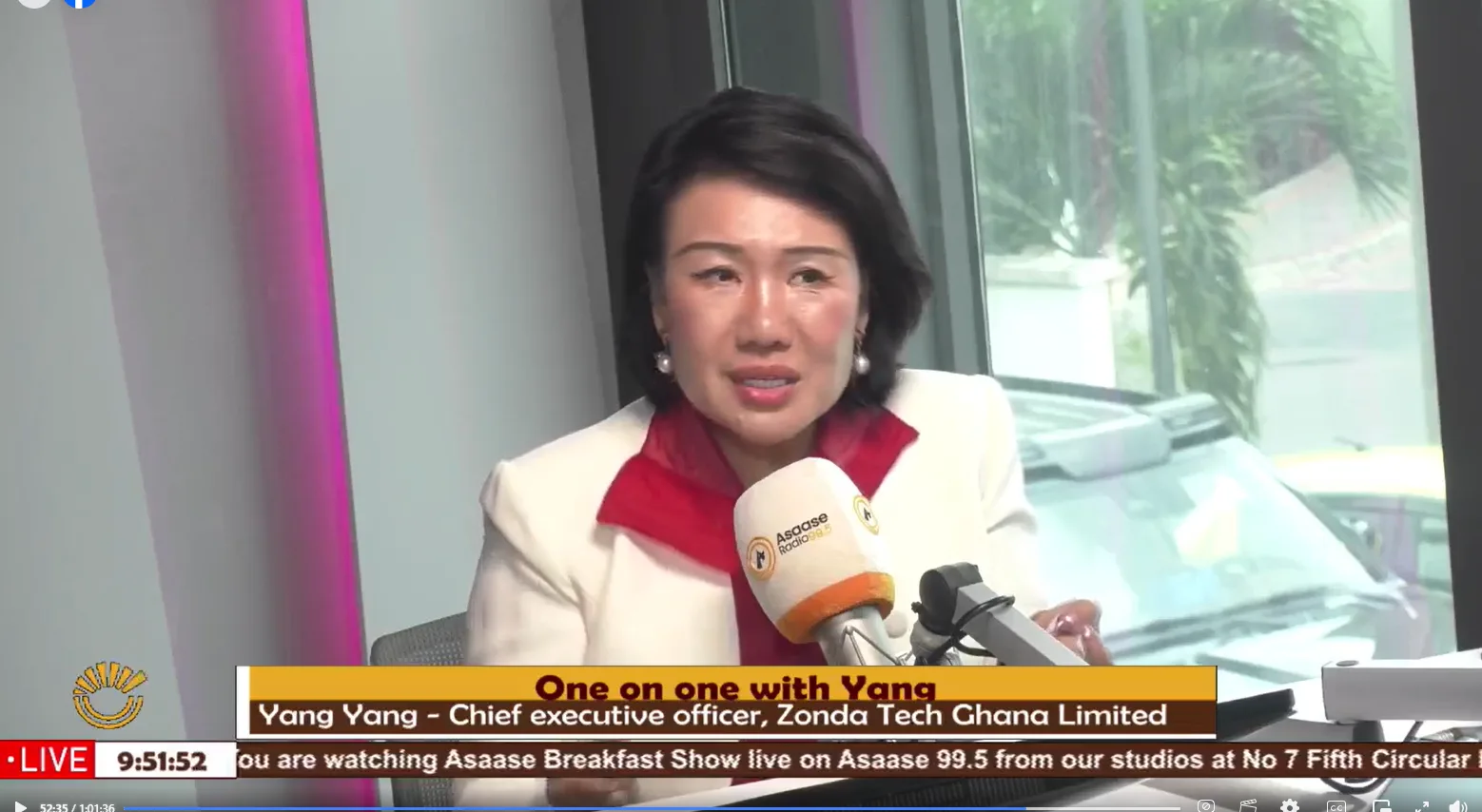
The Chief Executive Officer ofZonda Tech Ghana Limited, Yang Yang, has urged Ghanaians to take greater pride in locally assembled vehicles and support efforts to build a domestic automotive industry.
She said buying vehicles assembled in Ghana should be seen not simply as a consumer decision but as a contribution to the development of local engineering, manufacturing and employment.
Speaking on the Asaase Breakfast Show on Wednesday (19 August), Yang Yang said Ghana needed to cultivate a culture that valued local engineering and manufacturing.
“You need to feel proud that you’re using assembled in Ghana vehicle,” she said.
According to her, the development of a competitive automotive industry requires Ghanaians to recognise the value created by local engineers and workers.
She drew an analogy with road construction, saying people would naturally feel proud if a road they were using had been built by a family member.
“Today, if my father is assembling this vehicle, I feel proud of this vehicle because my father made it,” she said.
Yang Yang said Ghana had significant potential to develop its automotive sector because of its large youthful population and the availability of people willing to acquire new skills.
She said Zonda Tech had made training a central part of its operations rather than relying solely on workers who already possessed the required technical skills.
The company, she said, employs nearly 800 people and operates 13 branches across Ghana, with engineers and technicians receiving additional training, including programmes in China.
According to Yang Yang, the company’s investment in training was partly motivated by an encounter with a female mechanical engineering student who told her she had lost hope in her field of study.
“I was shocked. I said, you are from the best university for auto engineering… and now you say you don’t see hope,” she recalled.
Yang Yang subsequently invited the student to visit Zonda Tech’s assembly plant, saying the experience changed her perception of the career opportunities available to her.
She said the incident reinforced her belief that Ghanaian engineering students need to see tangible career opportunities in the automotive sector.
“In China we say we spend 10 years to plant a tree. We spend 100 years to cultivate a generation of capable youth,” she said.
Yang Yang said Zonda Tech’s expansion into vehicle assembly was part of a broader strategy to establish an automotive ecosystem in Ghana rather than remain solely a vehicle dealership.
She said the company began with the sale of trucks before expanding into machinery, servicing, spare parts, training and vehicle assembly.
She attributed part of the company’s growth to adapting imported vehicles to Ghanaian road conditions.
“Ghana’s road is not that good. So we have to do the research with the factory team and then we send all the information back to China. Let them design the suitable model for Ghana,” she said.
Yang Yang said after-sales service was equally important to building consumer confidence in Chinese vehicle brands.
She said Ghanaian consumers initially had reservations about Chinese vehicles, with many preferring Japanese and South Korean brands.
She therefore invested in training local engineers and establishing branches across the country to provide maintenance and after-sales support.
“When I started selling the GWM, Ghanaians, they didn’t trust much in that brand,” she said.
She said the company gradually sought to change perceptions about the quality of Chinese vehicles by combining the products with local technical support.
Yang Yang said her ultimate ambition goes beyond assembling vehicles to manufacturing components in Ghana.
She said such an expansion would create additional employment opportunities and deepen Ghana’s participation in the automotive value chain.
“Now I’m only assembling vehicles in Ghana,” she said, adding that her long-term dream was to establish further manufacturing capacity.
She urged Ghanaian policymakers and consumers to support the development of local automotive capabilities, arguing that the country’s young population provided a strong foundation for industrial growth.
“Ghana, you have your rich natural resources, gold. I say your people are your gold,” she said.