Implementation key to disability inclusion - Federation of Disability Organisations
Ghana must move beyond the formulation of disability-related policies and laws to ensure their effective implementation if persons with disabilities (PWDs) are to enjoy equal rights and opportunities, the Ghana Federation of Disability Organisations (GFD) has said. The federation said the true test of disability inclus...
Ghana must move beyond the formulation of disability-related policies and laws to ensure their effective implementation if persons with disabilities (PWDs) are to enjoy equal rights and opportunities, the Ghana Federation of Disability Organisations (GFD) has said.
The federation said the true test of disability inclusion was not the existence of policies but whether those policies translated into accessible services, infrastructure, education, employment and social protection for PWDs.
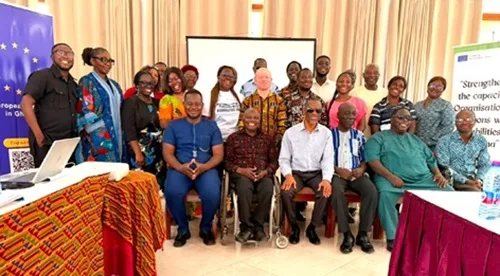
The call was made by participants in a two-day capacity-building programme on designing disability-friendly laws, policies and services organised by the GFD in partnership with the Mental Health Society of Ghana and the Africa Disability Institute in Akosombo on August 10 and 11, 2026.
The programme, supported by the European Union (EU), brought together Organisations of Persons with Disabilities (OPDs), government ministries and agencies, development partners and technical experts to examine how disability rights could be translated from policy documents into practical outcomes.
At the workshop, participants stated that the ultimate measure of progress should be whether PWDs could access public buildings, obtain information, receive quality education, secure decent employment and participate meaningfully in national decision-making.
They advocated stronger technical capacity and qualified leadership within the National Council for Persons with Disabilities.
They also renewed the call for “Nothing about us without us”, insisting that persons with disabilities must be involved from the beginning of policy formulation rather than being invited only to comment on decisions already taken.
The National President of the GFD, Joseph Atsu Homadzi, said providing services to PWDs was not a privilege but a right.
He said disability should no longer be viewed mainly through the lens of charity; rather, persons with disabilities must be treated as rights holders and active participants in national development.
The EU representative at the workshop, Mohammed Musah, reiterated that the real measure of progress in disability inclusion lay in implementation.
The Director, Policy Planning, Monitoring and Evaluation, Ministry of Labour, Jobs and Employment, Gloria Bortele Noi, said the ministry had established disability desks and public employment centres across the regions, but added that there had been concerns about the accessibility of some facilities.
The Principal Planning Analyst at the National Development Planning Commission, Lila-Karen Amponsah, said disability inclusion had been incorporated into the Medium-Term National Development Policy Framework, 2026–2029, as a specific focus, although acknowledging that reports were not yet consistently available in accessible formats.
The Head, Policy and Planning Directorate, Ministry of Education, Rose Bentsil-Quaye, said more than 2,300 students with disabilities were projected to benefit from free tertiary education in 2026.
She said the government also planned to provide free education for learners with special educational needs, including support for teaching materials, assistive devices, nutrition and welfare.
The Head of Monitoring and Evaluation, Ministry of Finance, Geoffrey Gargar, urged OPDs to participate actively in budget consultations, engage relevant ministries and agencies, submit evidence-based proposals and document the impact of disability programmes.
The GFD Project Officer on the EU Project, Evans Oheneba-Mensah, said the implementation of policies must be informed by evidence, lived experience and the meaningful participation of PWDs.
“We are grateful to the European Union for its support for this three-year project, which provides an important platform for strengthening evidence, building capacity and advancing more inclusive laws, policies and services.
“If we are serious about leaving no one behind, then PWDs must not simply be consulted at the end of the process; they must help shape the solutions from the beginning,” he said.