Ghana targets stronger local businesses and global markets with new investment strategy
The government says it is shifting Ghana’s investment strategy from simply attracting capital into the country to ensuring that investments translate into higher production, stronger local businesses, jobs and access to global markets. Minister for Trade, Agribusiness and Industry, Elizabeth Ofosu-Adjare, said the succ...
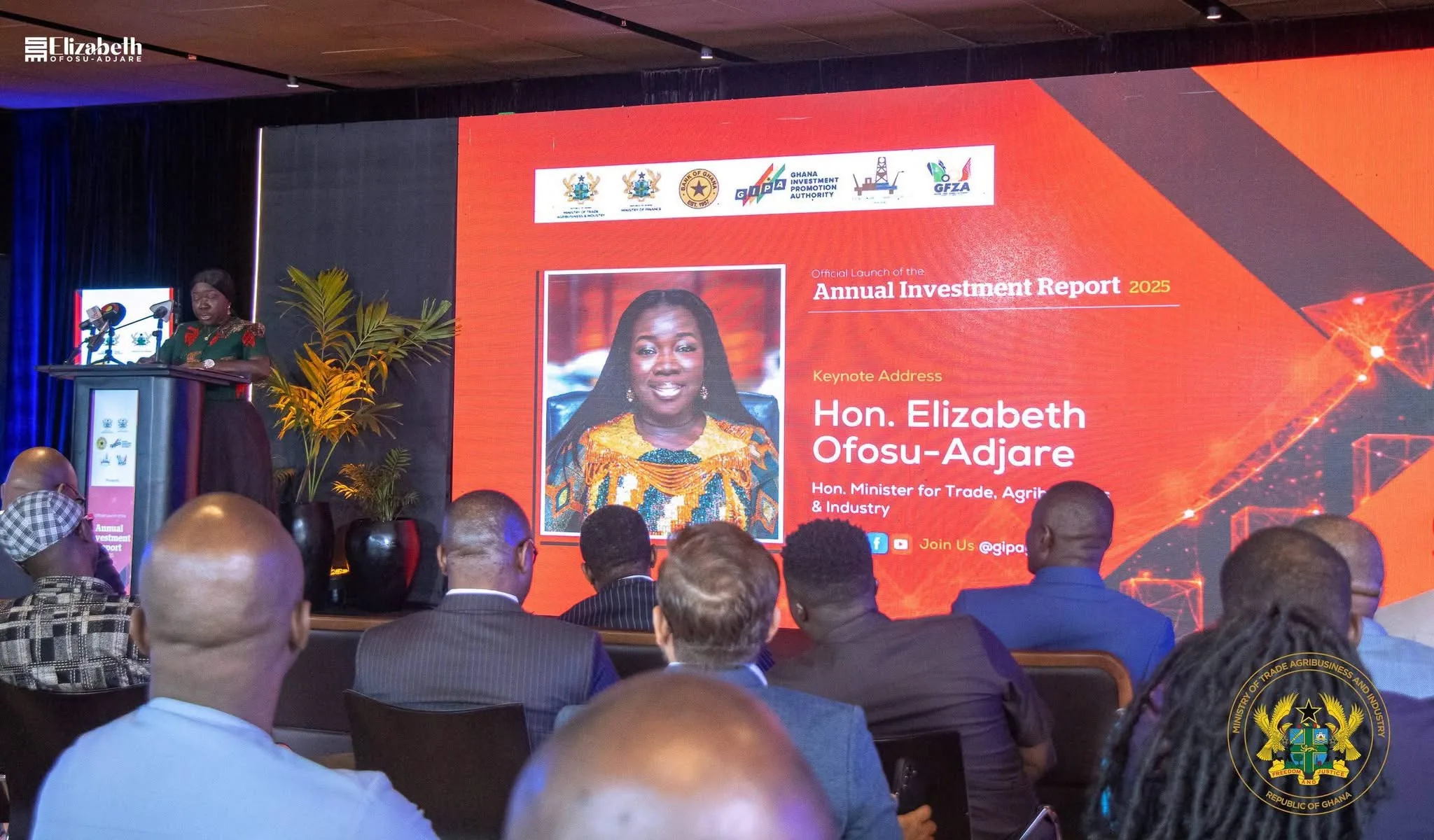
The government says it is shifting Ghana’s investment strategy from simply attracting capital into the country to ensuring that investments translate into higher production, stronger local businesses, jobs and access to global markets.
Minister for Trade, Agribusiness and Industry, Elizabeth Ofosu-Adjare, said the success of investment should be measured by the economic value created in Ghana rather than only the amount of capital attracted.
She was speaking at the launch of the Ghana Investment Promotion Authority’s 2025 Annual Investment Report at the Bank of Ghana in Accra on Friday, 21 August, 2026.
Ghana attracted about US$2.6 billion in foreign direct investment in 2025 through more than 250 new projects and existing companies, according to the minister.
She said significant reinvestment by companies already operating in Ghana was an indication of continued investor confidence in the country’s economic prospects.
However, Ofosu-Adjare said government’s priority was to ensure that such confidence translated into increased production and sustainable economic activity.
“Are they expanding our productive capacity, creating opportunities for Ghanaian enterprises, strengthening value chains and opening new markets for what we produce?” she asked.
She said government was particularly focused on developing industrial linkages, with agribusiness identified as one of the sectors with significant potential to create wider economic benefits.
According to her, processing agricultural produce locally would retain more value in Ghana while creating opportunities in packaging, transportation, warehousing, distribution and exports.
Government is also prioritising textiles and garments, pharmaceuticals, automotive manufacturing and components, and agro-processing as part of efforts to strengthen Ghana’s industrial capacity.
The minister said a predictable business environment would be critical to attracting and retaining investment, citing reliable infrastructure, access to financing, skilled labour, regulatory certainty and responsive public institutions as key requirements for investors.
She said the passage of the bill establishing the Ghana Investment Promotion Authority would strengthen investment facilitation and modernise Ghana’s approach to supporting investors in an increasingly competitive global market.
The ministry is also working towards the passage of the Business Regulatory Reform Bill.
Ofosu-Adjare said the proposed legislation would provide a framework for reviewing business regulations, strengthen public-private consultation and give businesses clearer guidance on compliance requirements.
She further urged businesses in Ghana to take advantage of the African Continental Free Trade Area by improving efficiency, meeting required standards and maintaining quality to compete in regional markets.
The minister encouraged investors expanding their operations to partner with local suppliers, use local inputs where possible and invest in skills development for young Ghanaians.
The 2025 report identifies nearly US$12 billion in announced and pipeline investments.
Ofosu-Adjare said government’s focus was to turn those commitments and opportunities into operational businesses that produce goods, create jobs and generate value within Ghana.
“Investment should leave a visible economic footprint in Ghana through expanded production, stronger local enterprises, productive jobs and greater access to regional and international markets,” she said.
She assured investors that government would continue working to improve the ease of doing business, strengthen coordination among public institutions and reduce delays that prevent investment decisions from translating into actual production.
The chief executive officer of GIPA commended the minister for her efforts to attract more investors into Ghana’s manufacturing sector.
He noted that manufacturing leads in terms of the number of projects, while mining services account for the highest value of foreign direct investment.
The governor of the Bank of Ghana, Dr Johnson Pandit Asiama, welcomed the findings of the report, describing them as evidence of renewed confidence in Ghana’s economy.
He said the report went beyond investment statistics to provide insight into the direction of investment and economic growth.
The launch also saw the signing of a Memorandum of Understanding between GIPA and the Oxford Business Group to collaborate on a global investment campaign for Ghana.