Golf Heritage Society’s 2026 Convention Is About More Than Collecting
The Golf Heritage Society’s 55th National Convention brings collectors, historians, writers and golfers to New York in September to preserve pieces of a game that can disappear surprisingly quickly.
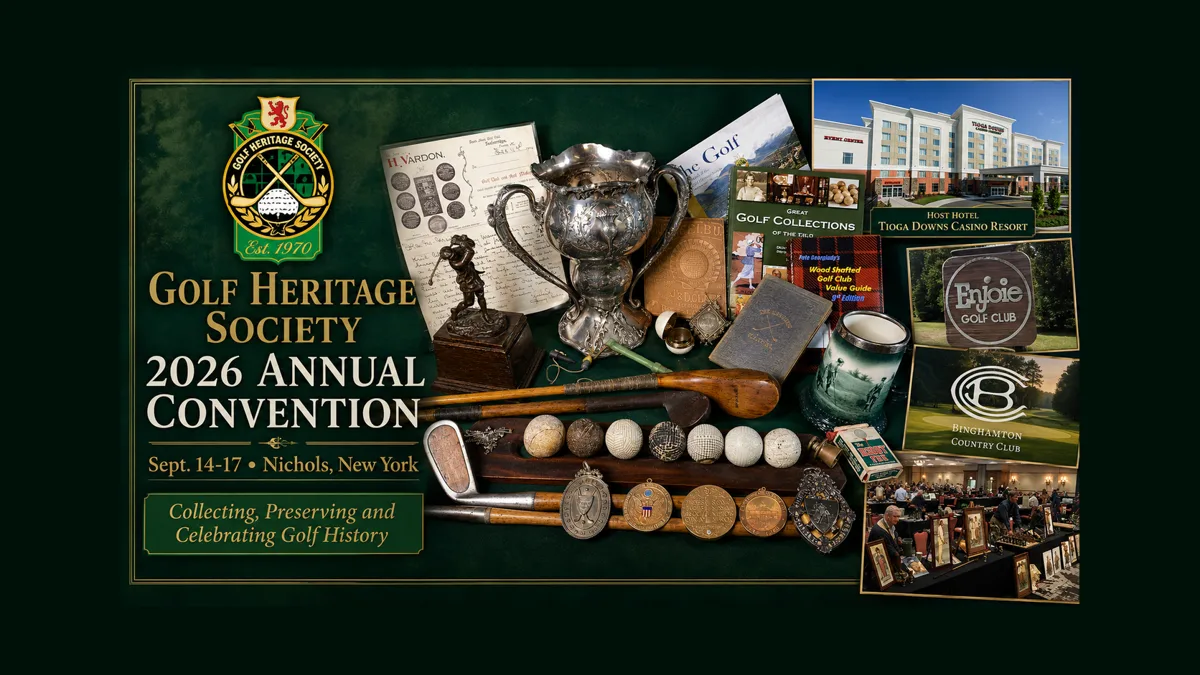
Golf has never been particularly good at throwing things away.
Old clubs find corners of garages. Scorecards get stuffed into desk drawers. Tournament programs remain on bookshelves for decades. A ball played during a meaningful round somehow survives three moves and eventually winds up in a box nobody remembers packing.
Most of those objects are worth very little.
Some are worth thousands.
Every one of them potentially has a story.
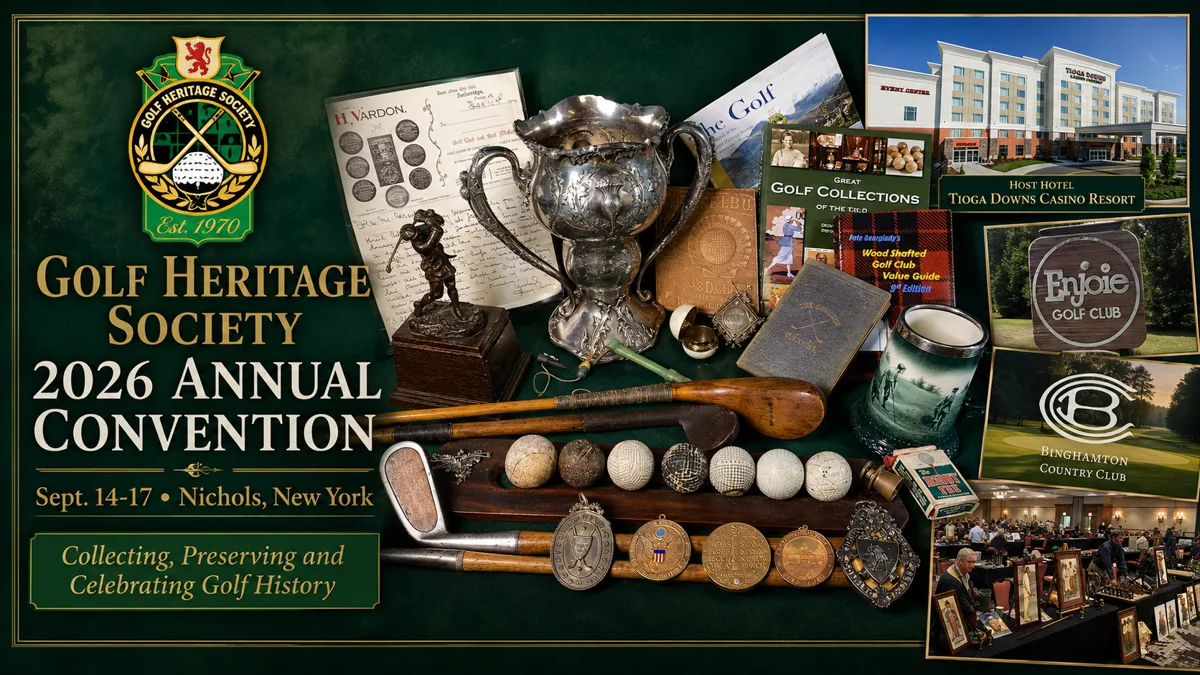
That intersection between golf, history and the things golfers leave behind is what will bring members of the Golf Heritage Society together Sept. 14-17 for the organization’s 55th National Convention in New York’s Southern Tier. The gathering will be based at Tioga Downs Casino Resort in Nichols, N.Y., with golf, educational programming and a collectibles trade show highlighting several days devoted to preserving the game’s past.
Calling it a collectors convention, however, misses much of the point.
The Golf Heritage Society includes writers, historians, architects, course superintendents, artists, PGA and LPGA members, amateur golfers and, yes, serious collectors. It was founded in 1970 as the Golf Collectors Society, but its modern mission is broader: promoting appreciation for golf history and traditions while connecting people who care about preserving them.
In a sport increasingly obsessed with what comes next, the convention is built around something different.
Remembering what came before.

The Golf Heritage Society brings together collectors, historians, writers, golf professionals, architects, superintendents, artists and everyday golfers who believe the stories, equipment and traditions of the game are worth preserving. Membership is not limited to serious collectors. If golf history fascinates you, there is a place for you here.
Golf History Is Often Hiding in Plain Sight
The fascinating thing about golf memorabilia is that significance and monetary value are not always the same thing.
A signed major championship flag may carry an obvious price. A rare hickory club might attract experienced collectors immediately. Early golf books, medals, tournament programs, artwork, balls, postcards and advertising pieces all occupy established collecting niches.
Then there are the objects whose importance requires somebody to recognize the story.
That is where organizations such as the Golf Heritage Society matter.
The Society traces its beginnings to Robert Kuntz and noted golf historian Joseph S.F. Murdoch, who founded the Golf Collectors Society in 1970. Today, GHS says it has nearly 1,000 members representing 15 countries, connected by interests ranging from equipment and championship memorabilia to course architecture and golf literature.
Its annual convention has become the organization’s centerpiece.
Informal room trading traditionally begins before the formal programming. Educational sessions bring historians and specialists together. Golf is played with everything from hickory and classic equipment to modern clubs. A banquet recognizes contributors to golf history.
Then there is the trade show.
GHS describes its annual collectibles show as the largest of its kind in the world, with material spanning golf’s earliest eras through the modern game. The trade show is open to the public.
That public component matters.
Someone does not need to know the difference between a guttie and a feathery, own a Tom Morris-era club or understand the market for vintage Masters badges to walk into a room filled with golf history and become curious.
Sometimes curiosity is where preservation begins.
GHS
The Convention Will Put Golf History Back on the Golf Course
The 2026 gathering also provides something a museum display cannot.
Participants get to play.
A special outing is scheduled Sept. 14 at Binghamton Country Club, a course whose design lineage includes A.W. Tillinghast. The GHS National Championship is scheduled for En-Joie Golf Course, a venue familiar to professional golf followers as the longtime home of the PGA Tour Champions’ DICK’S Open and, before that, the PGA Tour’s B.C. Open.
That combination fits the Society particularly well.
Golf history is not limited to artifacts sitting behind glass. Architecture matters. Equipment matters. The way the game was played matters.
GHS events have long included hickory golf, giving modern players a chance to experience at least part of the challenge confronted by generations using dramatically different equipment. The organization also offers classic-club and modern divisions, widening the invitation beyond dedicated hickory players.
That is a subtle but important point about preserving golf history.
The best history is not always something you look at.
Sometimes you swing it.
Sometimes you walk it.
Sometimes you stand on an old tee and begin to understand why a golf course was designed the way it was.
Collecting Has Become Part of Golf’s Modern Culture Again
There is also an interesting reason an organization founded more than half a century ago feels particularly relevant in 2026.
Golf collectibles are no longer confined to what many younger players might picture as an antique market.
Modern golf has created collecting cultures of its own.
Limited-edition putters and headcovers disappear almost instantly. Masters merchandise has become an annual phenomenon. Golf shoes, trading cards, pin flags and collaborations between golf and lifestyle brands can generate intense secondary-market interest.
The objects have changed.
The instinct has not.
A golfer buying a limited Scotty Cameron headcover today may not think of himself as doing the same thing as someone hunting for an early 20th-century golf ball, but both are participating in a basic tradition: attaching meaning to an object connected to the game.
Years later, some of those contemporary objects will become the historical artifacts somebody else searches for.
The Golf Heritage Society recognizes collecting areas that range from clubs, books, balls and postcards to Scotty Cameron items, tournament memorabilia, art, autographs and golf advertising.
There is room under this tent for far more than antiques.
That may be one of the Society’s best opportunities moving forward.
Golf heritage does not survive solely because established historians preserve the oldest pieces. It survives when another generation understands that the things being created today eventually become part of yesterday.
Preserving Golf Requires People, Not Just Objects
Golf tends to celebrate history selectively.
Major championship records remain easy to find. Famous shots survive indefinitely on video. The names of Nicklaus, Palmer, Woods, Hogan, Jones and Snead are secure.
But golf history becomes much more fragile as the spotlight narrows.
A local club championship trophy.
A scorecard from a course that no longer exists.
The correspondence of a club professional.
A photograph without names written on the back.
A handmade putter produced in tiny numbers.
Records from a regional tournament forgotten by everyone except the people who played in it.
Those stories can disappear in a single generation.
That is why golf preservation cannot depend entirely on institutions.
It also depends on individuals willing to ask what something is, where it came from and why it mattered before tossing it away.
The Golf Heritage Society’s stated mission centers on exactly that exchange of knowledge. Its meetings are intended to create connections among people who research, collect, write about and preserve golf history. It publishes the quarterly The Golf, maintains decades of searchable archives and holds regional events in addition to the national gathering.
The convention is where many of those pieces meet.
There will be golf.
There will be buying and selling.
There will undoubtedly be objects sitting on tables whose value creates some spirited conversation.
But the most important transactions in September may have nothing to do with money.
Someone will recognize an artifact another person could not identify.
Someone will hear a story he had never encountered.
Someone will meet the person who has been researching the same obscure corner of the game for 20 years.
And somebody who walks into the trade show merely curious may walk out understanding that golf history is not something completed long ago.
We are still making it.
The question is what we choose to save.
PGA of America Golf Professional Brendon Elliott is an award-winning coach and golf writer who serves as Athlon Sports Senior Golf Writer. Read his recent “The Starter” on R.org, where he is their Lead Golf Writer. To stay updated on all of his latest work, sign up for his newsletter or visit his MuckRack Profile.
Related: Monday Mowdown: As GCSAA Nears 100, Golf Salutes Its Unsung Heroes
Related: If You Love Golf, Join These Organizations and Groups
Related: Golf’s Future Depends on Remembering Its Past