BoG converts all Rural Banks into Community Banks in major sector reform
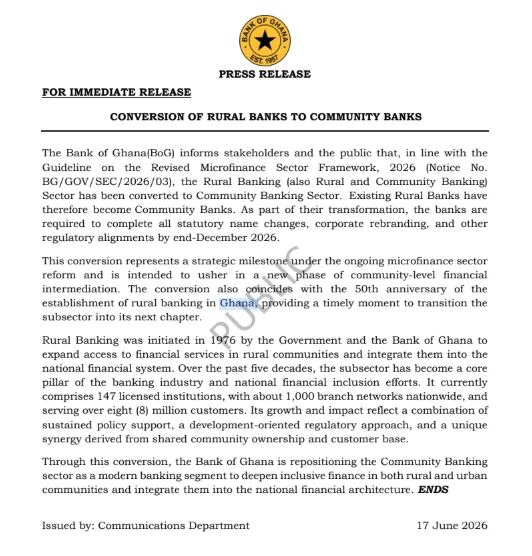
The Bank of Ghana (BoG) has announced the conversion of all Rural Banks nationwide into Community Banks as part of sweeping reforms to strengthen the microfinance sector and expand access to financial services. The central bank said the conversion takes immediate effect under the Guideline on the Revised Microfinance S...

The Bank of Ghana (BoG) has announced the conversion of all Rural Banks nationwide into Community Banks as part of sweeping reforms to strengthen the microfinance sector and expand access to financial services.
The central bank said the conversion takes immediate effect under the Guideline on the Revised Microfinance Sector Framework, 2026 (Notice No. BG/GOV/SEC/2026/03), with all existing Rural Banks now officially designated as Community Banks.
In a statement issued on June 17, the BoG described the move as a significant milestone in the ongoing transformation of Ghana’s microfinance industry.
According to the central bank, all affected institutions are required to complete statutory name changes, corporate rebranding and other regulatory adjustments by December 31, 2026.
The reform coincides with the 50th anniversary of rural banking in Ghana and is expected to usher in a new era of community-based financial intermediation.
“Through this conversion, the Bank of Ghana is repositioning the Community Banking sector as a modern banking segment to deepen inclusive finance in both rural and urban communities and integrate them into the national financial architecture,” the statement said.
Rural banking was introduced in Ghana in 1976 through a partnership between the Government of Ghana and the Bank of Ghana to improve access to banking services in underserved communities and facilitate their participation in the formal financial system.
Over the past five decades, the sector has grown into a key pillar of Ghana’s financial inclusion agenda and banking industry.
The Bank of Ghana noted that the sector currently comprises 147 licensed institutions operating nearly 1,000 branches nationwide and serving more than eight million customers.
The central bank attributed the sector’s growth to sustained policy support, a development-oriented regulatory framework and the community ownership model that has guided many of the institutions.
BoG said the conversion forms part of broader efforts to modernise the country’s financial sector while ensuring greater access to banking services in both rural and urban areas.
Although the central bank did not indicate whether the change would affect ownership structures or day-to-day operations, it stressed that all Community Banks must comply with the required regulatory and branding changes before the end of 2026.
Ghana Gas pays courtesy call on NPA CEO
GRA targets informal sector with modified tax scheme