“Young cocoa farmers are losing confidence” — Adu warns of crisis in the sector
Young cocoa farmers are demanding clarity from the government on the producer price and financing arrangements for the new cocoa season, warning that uncertainty and a lack of funds among licensed buying companies could further undermine confidence in the sector. Martin Adu, convener of the Young Cocoa Farmers Associat...
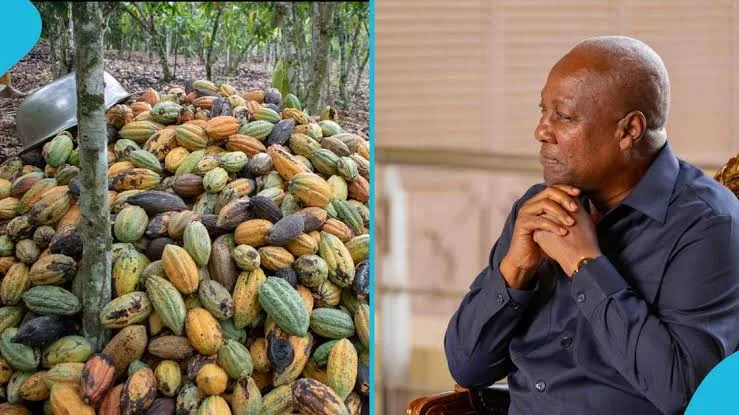
Young cocoa farmers are demanding clarity from the government on the producer price and financing arrangements for the new cocoa season, warning that uncertainty and a lack of funds among licensed buying companies could further undermine confidence in the sector.
Martin Adu, convener of the Young Cocoa Farmers Association, said farmers were still recovering from what he described as a sharp reduction in the producer price during the 2025/26 season and were uncertain about how much they would receive in the coming season.
He said the season began with a producer price of GH¢3,625 per 64-kilogramme bag, but was later reduced to GH¢2,587, resulting in losses of more than GH¢1,000 per bag for farmers.
“The situation where the whole thing reduced to the 2,587 per bag, it’s a big blow,” Adu said on the Asaase Breakfast Show on Tuesday (18 August).
He said the reduction had forced some farmers to cut back on farm maintenance because they could no longer afford the same level of investment.
Adu said farmers needed to know the new producer price, when the season would begin and whether sufficient funds would be available to buy cocoa throughout the season.
His comments come after what he described as widespread financing difficulties during the 2025/26 minor season, when some licensed buying companies and purchasing clerks struggled to pay farmers promptly for harvested cocoa.
“It was a very big blow to us,” he said, adding that the problem was not confined to one particular cocoa-growing area.
According to Adu, some farmers who had harvested and dried their cocoa were forced to keep their produce because buyers lacked the money to purchase it.
He said the situation also affected the informal credit arrangements on which many farmers depend to finance labour and farm inputs.
Traditionally, farmers can obtain advances from cocoa buyers to pay for labour and other expenses, with the money later deducted when they deliver their cocoa.
But Adu said buyers themselves were now struggling financially.
“As we speak, you go to the cocoa buyer, the clerks, and they even themselves, they would have wished to even come to you and then borrow from you. They don’t have the money,” he said.
He warned that delayed payments could have consequences beyond cocoa production because farmers rely on cocoa income to meet household expenses, including healthcare and school fees.
“If the farmer is unable to sell his produce, the cocoa produce, then it becomes a challenge, a big one of course,” Adu said.
He also said farm caretakers who depend on cocoa sales for their own income were affected when harvested cocoa could not be sold promptly.
Adu said the GH¢3,625 producer price announced at the beginning of the 2025/26 season was relatively acceptable to farmers because it appeared to take account of production costs.
However, he said the subsequent reduction to GH¢2,587 made cocoa farming increasingly difficult to sustain.
He estimated that a fair producer price should be more than GH¢4,000 per bag, given the cost of labour, fertiliser, pesticides, transportation and farm maintenance.
“The cost is so much,” he said, citing expenses associated with spraying farms and, in some areas, transporting water to farms because of the destruction of water bodies through illegal mining.
Adu said the current pricing system did not adequately reflect the actual cost of producing cocoa.
“Looking at the current price, it doesn’t reflect the current price at all because the cost is so much,” he said.
He said farmers were responding by reducing the amount they spent on farm maintenance, potentially affecting productivity.
Adu warned that continued uncertainty could discourage young people from entering or remaining in cocoa farming.
He said many young farmers were reluctant to invest heavily in their farms because they did not know whether the producer price would rise or fall in the coming season.
“The uncertainty is very high,” he said.
“If we don’t give out clear information and timelines for people to know that, well, this season this is how much we are going to get, this is the date where you are going to commence for the season, you won’t be able to plan yourself.”
He said the lack of profitability was already contributing to a loss of interest among young people, with some in cocoa-growing communities being attracted to illegal mining instead.
“If we don’t make the cocoa sector attractive, if the prices are not reflective of the cost that comes with it, I’m telling you that young cocoa farmers will not work on their farms,” Adu said.
He said the immediate priorities for young farmers were a fair producer price and adequate financing to ensure farmers could sell their cocoa without interruption.
“That is the assurance that if there will be a fair cocoa price and adequate funds to buy the cocoa from us,” he said.
Adu urged President John Dramani Mahama’s government to provide farmers with clarity on the new producer price, financing arrangements and the date for the start of the new cocoa season.
He said these assurances would allow farmers to plan their investments and determine how much they could afford to spend on their farms.